

VPIdeviceDesigner 3.0, released in May 2026, brings many exciting new features. The highlights of this release are the introduction of advanced optical fiber design and analysis features and enhanced S-matrix capabilities.
VPIdeviceDesigner 3.0 contains a collection of new classes, methods, and functions that enable the design and analysis of optical fibers based on their modal properties.
It supports arbitrary fiber cross-sections (single- and multicore, circular, elliptic, or other shapes, step-index or graded-index fibers), with a particular focus on doped silica materials and multicore fibers:
Create and use uniform and non-uniform dispersive materials based on a wavelength-dependent doped silica material model with an extendible library of dopants (predefined are GeO₂, B₂O₃, F, Cl).
Easily compose multicore fibers from individual core layouts or from measured refractive index or doping concentration profiles.
Activate and deactivate individual cores to characterize individual core modes, supermodes, and inter-core coupling.
The fiber-tailored finite-difference mode solvers (scalar and vectorial) support straight and bent mode calculations, allow to visualize the effective index and the modal fields Ψ or E and H,
and calculate the following datasheet parameters:
Effective index, group index, dispersion, dispersion slope; zero dispersion wavelength and slope using 3- and 5-term Sellmeier or polynomial fitting
Cut-off wavelength (theoretical, fiber, cable)
Mode field diameter (near field and far field) and numerical aperture
Effective mode area and confinement factor
Parameter definitions follow IEC 60793-1-42 and ITU-T G.650.1
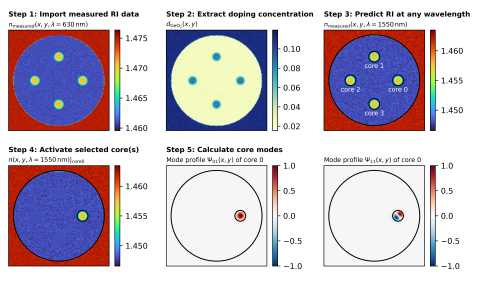
In addition, it offers advanced mode tracking capabilities for parameter sweeps, and the calculation of inter-core mode coupling coefficients for multicore fibers with arbitrary core positions and core shapes.
With its new fiber-specific features, VPIdeviceDesigner 3.0 can be used to design and analyze fibers for many scientific and industrial applications, including:
Standard single-core single-mode fibers
Single-core multi-mode fibers for data centers (OM1 to OM5)
Single-core few-mode for spatial division multiplexing (SDM)
Multicore fibers with arbitrary core layouts for SDM
Dispersion-compensated, dispersion-shifted, and non-zero dispersion-shifted fibers
Fiber designs for special applications: large effective mode area, high numerical aperture, ultra-low bending loss, polarization maintaining fibers
Advanced fiber designs: photonic crystal holey fibers, PANDA-type multimode fibers, ring-type hollow antiresonant fibers
S-matrices describe the behavior of passive linear devices (for example MMIs, X-Couplers, ...) in the frequency domain.
VPIdeviceDesigner calculates S-matrices with the beam propagation method (BPM)
or eigenmode expansion method (EME) and exports them to VPI Design Suite. In this release, we have significantly enhanced the capabilities of the S-matrix object. Users can now:
update or change individual transfer functions,
export and import parametric S-matrices, i.e. S-matrices that contain S-parameters that depend on the wavelength and one additional parameter, e.g. a device width, fully compliant with VPIdesignSuite's S-matric file format,
create bi-directional reciprocal S-matrices from uni-directional BPM simulations, and
flexibly rename port and mode names to align with any naming scheme required by the targeted circuit-level simulation tool.
These enhancements enable you to use VPIdeviceDesigner to post-process, polish, and prepare simulated or imported S-matrices for circuit-level simulations programmatically in Python.
The scalar mode solver can now calculate bent waveguide modes, which is important, e.g. for the characterization of optical fibers. The scalar solver now returns true scalar modes, represented by a single scalar mode field Ψ.
All calculated mode objects are extended by a group delay property. All spectral mode properties offer the possibility to obtain the fitting function expression and its coefficients.
A new predefined "hook" calculates the mode confinement factor for arbitrary waveguide core geometries. To enable that, we added a flexible layout-filtering function that allows to extract the core geometry from the whole waveguide
cross-section programmatically.
Vector fields can now be rotated and mirrored, taking the vectorial character into account and properly transforming the components into each other. This is helpful for mode symmetry analysis.
Far fields (on a distant half-sphere) can be calculated from near fields defined on a finite rectangular screen.