

VPIphotonics Design Suite comprises professional application-specific simulation tools and add-on toolkits for photonic and optoelectronic components as well as for complete optical systems targeting communications, computing, sensing, and other applications. They provide flexible usability features, versatile analysis capabilities, and a custom design process tailored for day-to-day engineering and leading-edge research.
Version 11.7 significantly advances simulation and design flows for many applications, including datacom and accelerated computing, laser satcom, high-capacity networks, fiber sensing,
integrated photonics and optoelectronics.
The latest version addresses key industry needs by delivering significant improvements in modeling accuracy, flexibility, and simulation speed, underscoring our commitment to
delivering practical, industry-focused tools that accelerate photonic innovation.
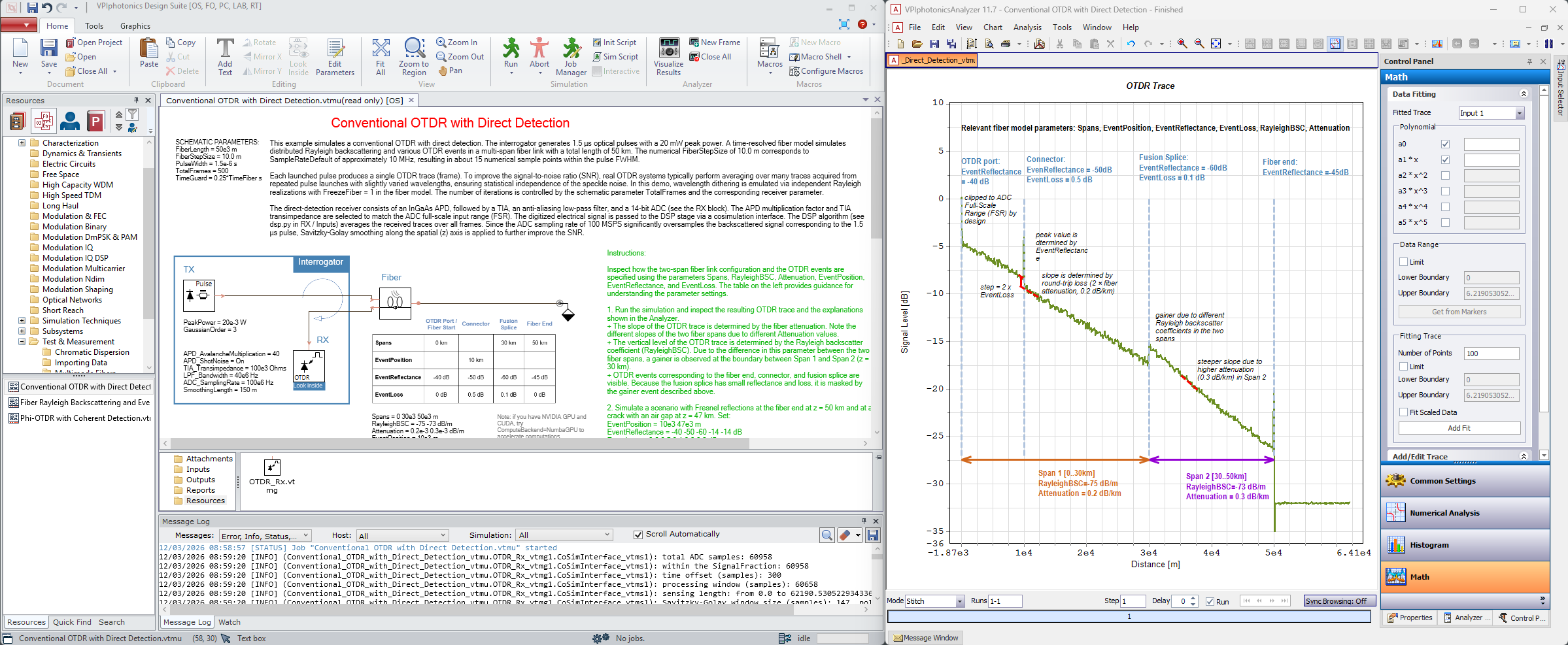
Photonic Design Environment (PDE) of Version 11.7 with exemplary demonstrations
New electrical PAM transmitter demo module supporting an arbitrary number of PAM levels, allowing the generation of different flavors of PAM, such as PAM-3, PAM-6 and PAM-8
Demo illustrating PAM-3/4/6/8 system alternatives for 200 Gb/s O-band transmission for Data Center Interconnects (DCIs)
Demo showcasing 53 Gbaud PAM4 single-channel transmission in accordance with the 100G-DR-LPO MSA, including FFE/DFE-based equalizers for Tx/Rx-SerDes and CTLE for analog electrical driving
Enhancements of BER estimation modules, including multiple outputs to be returned simultaneously, file report of fitting parameters, and refined optimum threshold estimation
New modules improving the flexibility for specifying electrical input/output connections for optical IQ modulators with polarization-multiplexing and corresponding optical coherent frontends
Revised coherent receiver modules to prevent Noise Bins from reaching the 90-hybrid, thereby avoiding non-physical behavior
Demo illustrating how the channel-by-channel performance of a coherent N x 120 Gbaud DP-16QAM WDM system can be efficiently assessed using a single-channel receiver only
DSP library with FIR filtering algorithm supporting multi-column inputs, and processing real-valued single-channel signals, reducing the multi-channel DSP pre-processing effort
DSP library with refined CD compensation algorithm resulting in improved filtering performance on high-bandwidth coherent links, such as 800G ZR+ scenarios
Demo illustrating the sources of equalization enhanced phase noise (EEPN) in high-bandwidth long-haul links and illustrating its performance impact in a DP-16QAM 124GBd system
Enhanced Gaussian noise (EGN) model that accounts for ISRS, dispersion slope and span coherence
Demo emulating the signal performance in a wideband coherent WDM system, being affected by nonlinear distortions, including ISRS (calculated by the EGN-ISRS model), and ASE-noise
New Fiber Rayleigh backscattering module for Distributed Fiber Optic Sensing systems featuring time-resolved Rayleigh backscattering, multiple fiber spans, discrete events, time- and space-dependent strain, bidirectional propagation
Demo of a conventional OTDR system with direct detection, investigating the impact of fiber attenuation, Rayleigh backscatter coefficient, and event parameters on the OTDR trace
Demo illustrating a phase-sensitive OTDR system for distributed acoustic sensing (DAS), detecting phase and strain variations along the fiber using coherent reception and an exemplary DSP chain
Enhanced FSO coherent channel model: improved coupling-statistics model and calculation of key turbulence-defining parameters, independent speckle contributions with amplitudes from LogNormal or Gamma-Gamma distribution, Gaussian-beam approximation for computing scintillation index and phase variance of the coherent cells
Demo of the turbulent FSO coherent channel showcasing the calculation of coupling coefficients using discrete sampling of phasors across the aperture
FSO phase screen generator module to include "Subharmonics" when generating phase transfer function files, improving the representation of large-scale eddies below the FFT cut-off frequency
Demo illustrating the coupling of a Gaussian beam, distorted by atmospheric turbulence, into a single-mode fiber for satellite downlink communication using the backpropagation method
Efficient two-way file transfer between the simulation and the package folders, allowing, for example, reading from and writing to the same data file
Simplified creation of multiple schematic parameters at once by selecting several target parameters and dialog-assisted assignment of new schematic parameters
Parameter values can be displayed in the module's tooltip when hovering the mouse over it
Visual indication of different parameter values in the Parameter Editor when editing parameters of multiple modules simultaneously
Single-step clean up of orphaned Python environments, for instance, from previous installations, in the Preferences
New Import Netlist and Export Netlist macros, allowing for the conversion of a simulation schematic to/from a netlist listing its components and their connections
Optimized IIR filter design algorithm, speeding up execution of integrated photonic component modules such as ModulatorMicroRing, DelaySignal, PhotonicsTLM, WaveguideModulator, Waveguide, WaveguideNL, and SOA_Measured
Demo illustrating thermal effects simulation and automated detuning compensation for a thermally stabilized MRM using a PID-based feedback control system
Enhanced Visualize PhotonicsTLM Structure macro supporting the specification and visualization of current and voltage contacts to PhotonicsTLM sections from the macro GUI
Waveguide modulator module supporting block mode with aperiodic boundary conditions, simplifying and speeding up relevant simulations
Updated hybrid mode locked laser demos simulating the saturable absorber using an EAM section, integrated with DBR, passive and gain sections within a single PhotonicsTLM module
Demo showcasing how to link device-level simulation and circuit-level performance assessment for efficient PIC design using a silicon nitride MRR add-drop filter as an example
Enhanced reading and processing of file-based optical S-matrices: file size reduction and readability improvement by referencing once defined transfer data instead of duplicating it, and new parameters enforcing polarization symmetry and reciprocity of the data
New demo module to efficiently visualize large S-matrices containing hundreds of ports and mode combinations
S-matrix files inspection within the Create Measured Passive Component macro workflow, enabling validation of the raw data before generating the corresponding circuit component
Enhanced Characterize Passive Circuit macro: support of unidirectional ports and/or multiports, custom central frequency or wavelength for characterization, application within composite modules
Support for a scattering-matrix (S-matrix) based approach with custom parameter dependencies, implemented via a new module SmatrixMeasuredEl, to describe the electrical properties of active optoelectronic devices
Demo comparing a linear equivalent circuit model with the frequency-dependent RF response read from file for variable junction capacitances
Enhanced S-matrix assembly algorithm and added control parameters for a faster and more memory-efficient simulation of linear electrical circuits in the SMATRIX domain
New module helping to reduce the simulation time by recording/replaying data, and thus eliminating repetitive computations for static parts of a schematic
New multiport input/output co-simulation modules for the creation and manipulation of integer-, float-, and complex-valued matrix-type data signals
New modules enabling matrix or float-value computations with an arbitrary number of inputs and outputs
Enhanced Jupyter Interface enabling function-based alternatives to magic commands for improved clarity; parameter handling and improved stability for large data
JupyterLab, along with required Python packages, and Numba (open-source JIT compiler generating fast machine code) added to the distribution; upgraded versions of NumPy, SciPy, matplotlib (and related packages) provided
Interpretation of an electrical signal as voltage or current in the Analyzer, and, in combination with a specified impedance, conversion between volts, amperes, and watts
Updated Analyzer window allowing users to control the overall window and content size, and the chart aspect ratio and alignment
Enhanced Analyzer export wizards: image export with visual chart adjustment and required DPI and image size (including properly scaled chart elements), data export allowing selection of all traces at once
Version 11.7 provides access to more than 1,000 ready-to-run simulation setups. New and improved demo examples illustrate the application of the new features and modules.
The application example showcases 53.125 Gbaud PAM4 single-channel transmission for datacenter interconnects in accordance with the 100G-DR-LPO MSA.
The system uses a realistic model of the analog electrical channel and a continuous-time linear equalizer (CTLE). The electrical drive signal is optimized by
training the equalizer at the SerDes transmitter. Co-adaptation of feed-forward and decision feedback equalization (FFE/DFE) is performed at the SerDes receiver.
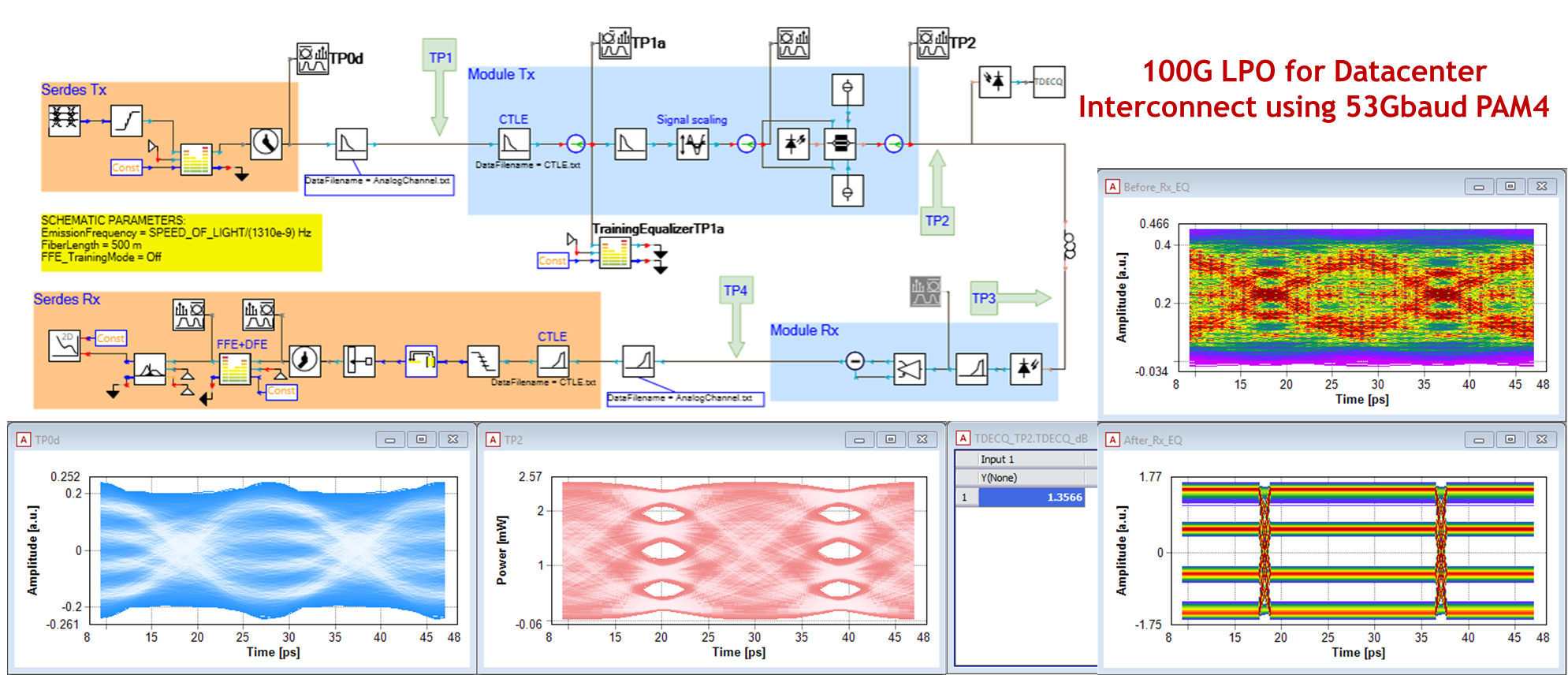
Setup & Results for PAM4-based 100G system for Linear Pluggable Optics